Stop searching through batch records and certificates of analysis. Start asking them questions.
Document Intelligence by Katalyze turns batch records, certificates of analysis, recipes and process records, lab reports, deviation records, SOPs and transfer documentation, on paper, in scans and in PDFs from your labs, suppliers, CROs and CDMOs, into structured, source-linked data your teams can review, analyze and trust.


The records are there. Using the data still takes work.
Batch records, certificates of analysis, recipes, lab reports and deviation records hold the information your teams need, but understanding a complete record and its meaning still requires experts to find the relevant values, interpret the tables and notes, and transfer the information into another file or system.
- Find the values in a long record
- Interpret the tables, symbols and notes
- Re-key them into another file or system
- Every value is read into your schema, linked to its page
- What it is unsure of is flagged for your experts
- The data is ready for your systems and Agentic Solutions
Free your experts to advance the science.
See it workSee a batch record become usable data.
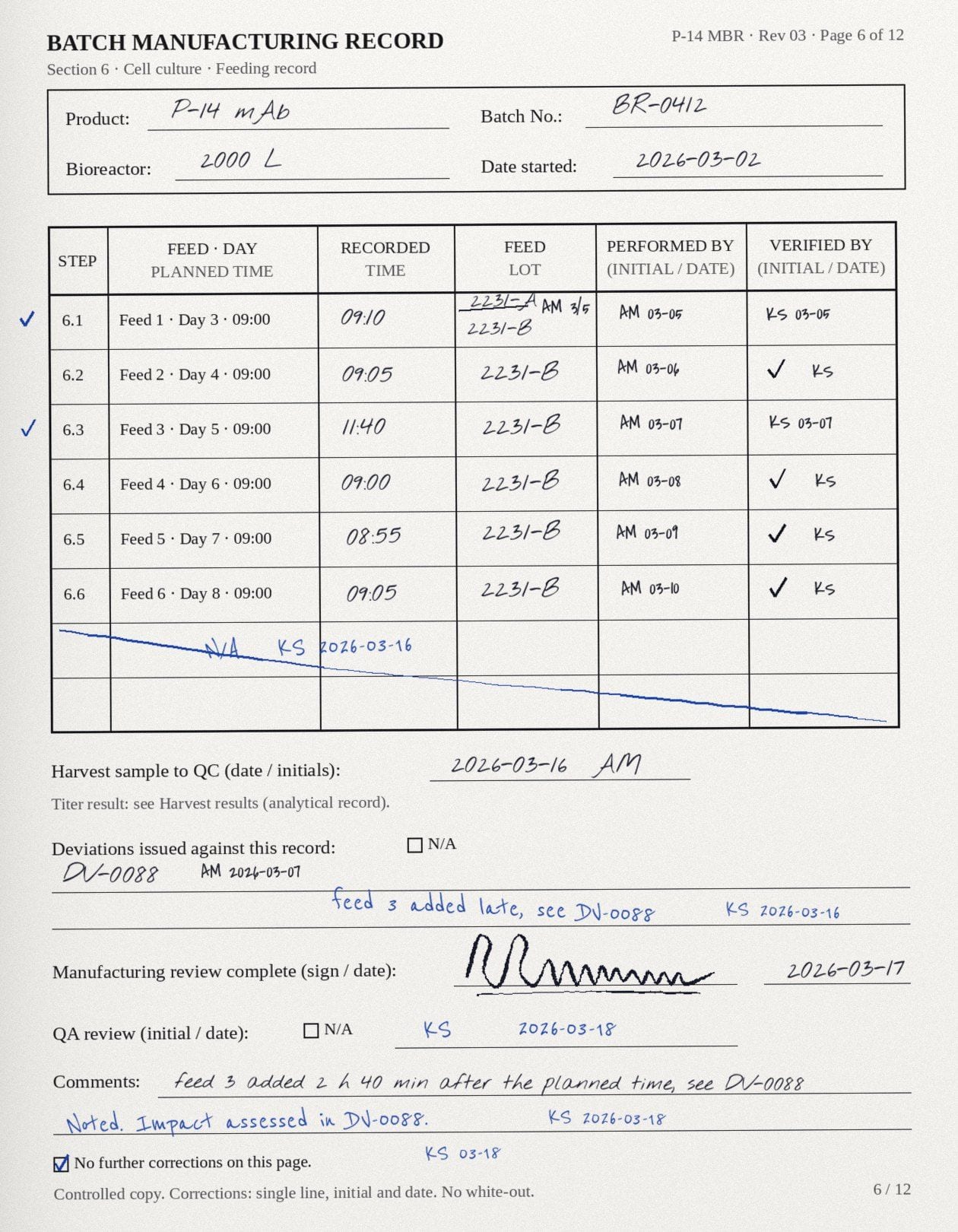
On the left, the record as it arrived: printed form, handwritten values, a correction, a margin note, scribbles and checkmarks. On the right, the same page digitized into your schema: every value with what the form called it, where it was read and what still waits for review.
Ask your data a question| Field | Read from | Value | State |
|---|---|---|---|
| Header | |||
| ProductProduct | p. 6 · header | P-14 mAb | |
| Batch numberBatch No. | p. 6 · header | BR-0412 | |
| BioreactorBioreactor | p. 6 · header | 2000 L | |
| Date startedDate started | p. 6 · header | 2026-03-02 | |
| Feeding record, section 6 | |||
| Feed 1, recorded timeRecorded time | p. 6 · step 6.1 · handwritten | 09:10 · planned 09:00 | |
| Feed lotFeed lot | p. 6 · step 6.1 · corrected, AM 03-05 | 2231-B · corrected from 2231-A | |
| Feed 2, recorded timeRecorded time | p. 6 · step 6.2 · handwritten | 09:05 · planned 09:00 | |
| Feed 3, recorded timeRecorded time | p. 6 · step 6.3 · handwritten | 11:40 · planned 09:00 | |
| Feeds 4 to 6, recorded timesRecorded time | p. 6 · steps 6.4 to 6.6 · handwritten | 09:00 · 08:55 · 09:05 · planned 09:00 | |
| Feeds verifiedVerified by (initial / date) | p. 6 · steps 6.1 to 6.6 | KS · every feed | |
| Rows 6.7 to 6.8(rows crossed through) | p. 6 · rows struck, KS 2026-03-16 | Not used | |
| Harvest sample to QCHarvest sample to QC (date / initials) | p. 6 · harvest line · handwritten | 2026-03-16 · AM | |
| Titer resultTiter result: see Harvest results (analytical record) | p. 6 · printed line under the harvest sample | See Harvest results | |
| Review | |||
| Deviation issuedDeviations issued against this record | p. 6 · deviations line | DV-0088 · AM 2026-03-07 | |
| Margin note(margin) | p. 6 · margin, KS 2026-03-16 | feed 3 added late, see DV-0088 | Review |
| Manufacturing reviewManufacturing review complete (sign / date) | p. 6 · review block | Signed · 2026-03-17 | |
| QA reviewQA review (initial / date) | p. 6 · review block | KS · 2026-03-18 | |
| No further correctionsNo further corrections on this page. | p. 6 · footer, KS 03-18 | Yes · box checked | |
Ask your data a question. The answer is sourced and connected thanks to Document Intelligence.
Once the records are data, your teams ask Katalyze questions in plain language. An answer can draw on several records at once, and it cites each one it was read from, so an expert can check it against the page.
Book a DemoWhich P-14 batches recorded a feed addition later than planned, and how did their harvest titer compare?
Two of the twelve in the comparison set: BR-0412 and BR-0421. On both, the feeding record shows feed 3 recorded later than the master batch record planned; on BR-0412 at 11:40 against 09:00, with a margin note referring the late addition to DV-0088.01
Both recorded lower harvest titer than the other batches in the set. BR-0415, fed as planned, was comparable.02
All three used feed lot 2231-B, under certificate 0091. The comparison does not separate feed timing from the lot.03
Follow-upWhat does DV-0088 record so far, and is it still open?
How it works: contextualized data extraction.
A workflow made from reusable extraction, assembly, rules, review and egress steps, built from scratch for the pharmaceutical manufacturing industry.
Explore the Context Layer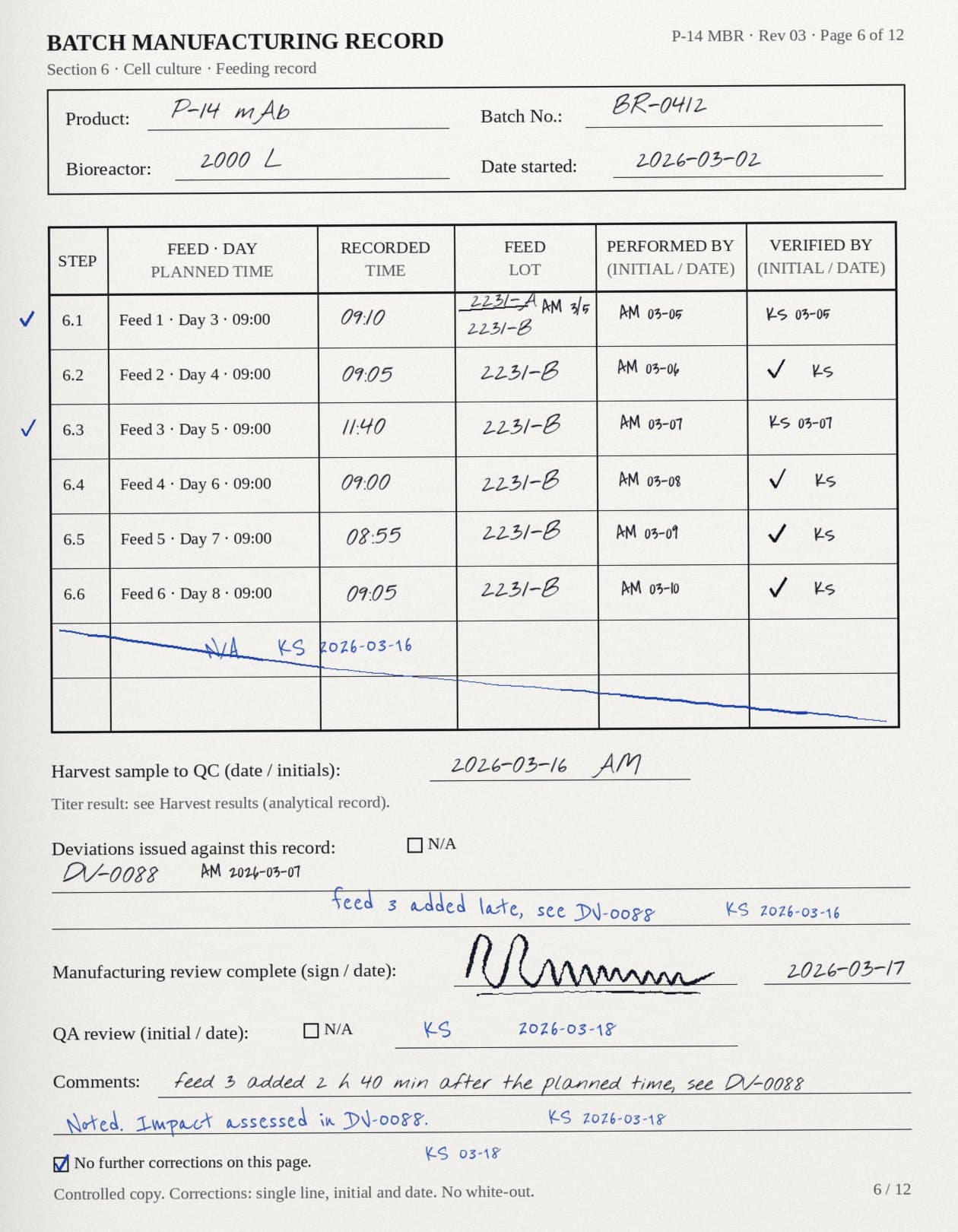 010203
- 01Feed lot2231-B, correctedfeeding record
- 02Feed 3, recorded11:40feeding record
- 03Margin notefeed 3 added late, see DV-0088page margin
- Batch recordBR-0412 · 12 pages
- Certificate of analysislot 2231-B · PDF
- Master batch recordP-14 · Rev 3 · PDF
| Field | Value | Read from | |
|---|---|---|---|
| Feed lot | 2231-B, corrected | feeding record | |
| Feed 3, recorded | 11:40 | feeding record | |
| Margin note | feed 3 added late, see DV-0088 | page margin | |
| Certificate | 0091 | certificate header | |
| Feed 3, planned | 09:00 | master batch record |
| Field | Value | Rule | State |
|---|---|---|---|
| Feed lot | 2231-B, corrected | Lot on record | |
| Feed 3, recorded | 11:40 | Deviation if late | |
| Margin note | feed 3 added late, see DV-0088 | Refers to a deviation | Review |
| Certificate | 0091 | On file for the lot | |
| Feed 3, planned | 09:00 | Current revision |
| Field | Value | Read from | State |
|---|---|---|---|
| Feed lot | 2231-B, corrected | feeding record | |
| Feed 3, recorded | 11:40 | feeding record | |
| Margin note | feed 3 added late, see DV-0088 | page margin | Confirmed |
| Certificate | 0091 | certificate header | |
| Feed 3, planned | 09:00 | master batch record |
- Context Layerwith the data from your systems
- Deviation Investigation · DV-0088
- Yield Optimization
- Your systems
Designed for pharmaceutical records.
Work with long, complex documents containing tables, diagrams, scientific notation, handwriting and inconsistent formats. Batch records and certificates of analysis are where teams commonly begin; within an Agentic Solution the document set is selected for the job.
Book a DemoBatch record
The executed record of one batch: printed forms filled in by hand across dozens of pages, with corrections struck once and initialed, notes in the margin and a signature on every review.
- Header fields
- Process tables
- Hold times
- Yields
- Corrections
- Margin notes
- Signatures
Traceable by design.
Document Intelligence by Katalyze works within your organization's validation and approval framework: extracted information stays linked to the original page, flagged exceptions go to your experts before anything moves downstream, and every run is recorded. Nothing is re-keyed by hand, nothing uncertain is filled in, and nothing flagged moves on without a person. Built for GxP environments and processes.
- 01 Source-linked dataInspect the original evidence behind extracted information.12 pages readBatch record BR-0412, a paper scan: 18 fields, 1 table, 2 corrections and 1 margin note, each keeping the page and the region it was read from12 pages
Connect the records to the rest of your operation.
Agentic Solutions use this source-grounded context to establish ground truth, investigate with evidence and execute governed work. Start with the documents and data needed for the first operational job; the same Context Layer can be reused and expanded as additional solutions are introduced.
All Agentic Solutions- 01Agentic SolutionExplore Deviation Investigation
Deviation Investigation
Assemble and validate relevant evidence to investigate possible causes.
- 02Agentic SolutionExplore Yield Optimization
Yield Optimization
Connect recipes, process records, material data and system data to investigate yield performance.
- 03Agentic SolutionExplore Raw Material Characterization
Raw Material Characterization
Connect material, supplier and scientific information to investigate variability.
- 04Agentic SolutionExplore Tech Transfer
Tech Transfer
Assemble process knowledge and supporting evidence to prepare transfer documentation and action plans.
Scientists and engineers use Katalyze to investigate, improve and advance.
What teams started with, what their records became and what changed for the scientists and engineers who use them.
See customer resultsQuestions about Document Intelligence.
What it reads, how it handles tables and handwriting, and where the data goes. The full set of answers is in the FAQ.
Put the information in your records to work.
Bring the job you want to move forward and the records you'd like connected. Thirty minutes on how Katalyze would do the work, and where your experts come in.
Or, just a quick chat to run through the product, your call.