Blog
Notes from the team.

True copies, scanned batch records, and data integrity
A scanned batch record can stand in for the paper original only if it is a true copy: a copy verified, by a dated signature or a validated process, to preserve the original's full content and meaning, including the metadata needed to reconstruct the activity. FDA's 2018 data integrity guidance and MHRA's 2018 guidance both set this expectation, and 21 CFR 211.180 allows GMP records to be kept as true copies. A true copy is still an image, though; digitizing its contents into data is a separate step with its own integrity requirements.
Read the post- Document DigitizationHow to digitize certificates of analysis from suppliers
Digitizing a supplier certificate of analysis (CoA) means extracting the material, lot, tests, specifications, results, and methods into one schema, with each value linked to the certificate it came from, whatever layout the supplier used. The steps are to define one schema for every supplier, map each supplier's terms to it, extract, check the results against the specification, and review anything flagged. Structured certificate data makes it practical to trend a supplier's results across lots and to support the verification of supplier data that 21 CFR 211.84 requires.
- Document DigitizationHow to digitize paper batch records without losing the source
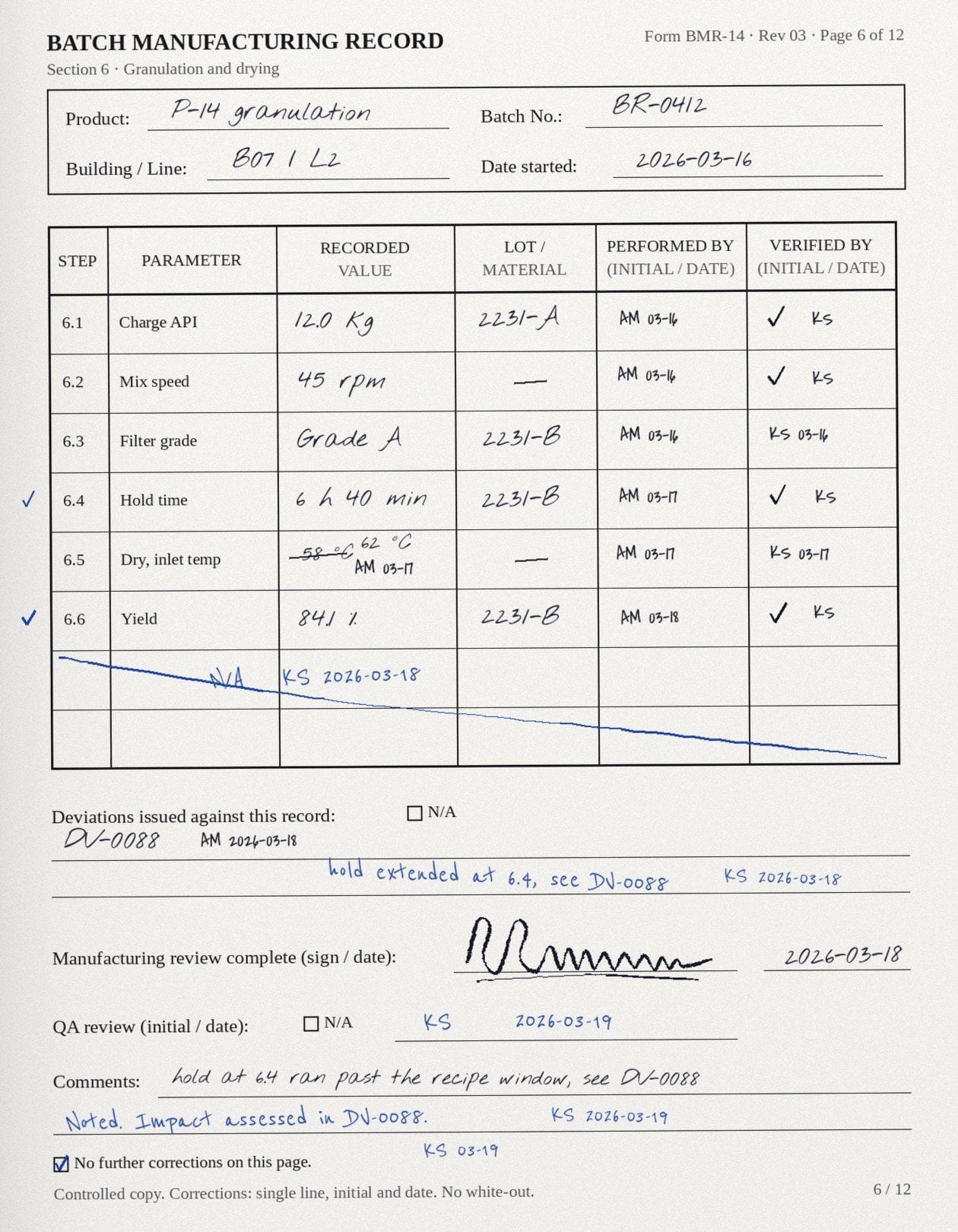
Digitizing a paper batch record means reading every value on the executed record, including handwritten entries, corrections and signatures, and loading into a defined schema, with each value linked to the location it came from. The steps are to define the schema, capture a good image, extract, check against rules, have an expert review flags, and deliver the approved data. Keeping the link to the source at every step is what makes the result usable in regulated work.
- AI in GxPWhat FDA's draft AI guidance asks for, and what it leaves out

FDA's draft guidance Considerations for the Use of Artificial Intelligence To Support Regulatory Decision-Making for Drug and Biological Products, issued in January 2025 and still a draft as of September 2026, sets out a seven-step, risk-based framework for establishing that an AI model is credible for a defined context of use. It applies to AI that produces information supporting regulatory decisions about a drug's safety, effectiveness, or quality. It excludes AI used in drug discovery and AI used for operational efficiencies that do not affect patient safety.
- Deviation InvestigationWhy unstructured records slow regulated operations

In pharmaceutical operations, much of the evidence behind a batch sits in unstructured records: paper batch records, supplier certificates of analysis, lab reports and deviation records that no system can query. The records are complete and controlled, but answering a question across them means finding, reading, and retyping them by hand. That slows investigations, supplier qualification, and batch review, and it keeps experts on assembly work. Turning those records into structured, source-linked data removes that step without replacing the systems that hold them.
- AI in GxPEU GMP Annex 22 and the revised Annex 11: what the drafts ask of AI systems

EU GMP Annex 22, published as a draft for consultation on July 7, 2025 alongside revised drafts of Annex 11 and Chapter 4, is the first GMP text written specifically for artificial intelligence. It applies to static AI models used in critical GMP applications, says generative AI and large language models should not be used in those applications, and requires a qualified person to check outputs where AI is used in non-critical ones. The consultation closed on October 7, 2025, and as of September 2026 none of the three documents had been adopted.
All posts: 5 of 5 shown
A weekly letter from Katalyze.

See Katalyze on your operation.
Bring the job you want to move forward and the records you'd like connected. Thirty minutes on how Katalyze would do the work, and where your experts come in.
Or, just a quick chat to run through the product, your call.