True copies, scanned batch records, and data integrity


In brief
A scanned batch record can stand in for the paper original only if it is a true copy: a copy verified, by a dated signature or a validated process, to preserve the original's full content and meaning, including the metadata needed to reconstruct the activity. FDA's 2018 data integrity guidance and MHRA's 2018 guidance both set this expectation, and 21 CFR 211.180 allows GMP records to be kept as true copies. A true copy is still an image, though; digitizing its contents into data is a separate step with its own integrity requirements.
Key takeaways
- FDA's 2018 data integrity guidance says electronic copies can be used as true copies of paper records if they preserve the content and meaning of the original, including its metadata.
- MHRA's 2018 guidance defines a true copy as one verified by a dated signature or generated through a validated process.
- 21 CFR 211.180(d) allows GMP records to be kept as original records or as true copies.
- A scan can be a true copy of a static record such as a paper batch record, but a printout is not a true copy of a dynamic record such as reprocessable chromatography data.
- Whether originals can be destroyed after a true copy is made is a decision for the operation's quality system and risk assessment, not something the guidance makes automatic.
What a true copy is
MHRA's 'GXP' Data Integrity Guidance and Definitions (March 2018) defines a true copy as a copy of the original record, on any media, that has been verified, by a dated signature or by generation through a validated process, to hold the same information as the original, including the data that describes its context, content and structure. WHO's 2021 data integrity guideline uses the same wording for a certified true copy. FDA's 2018 guidance does not give a formal definition, but in its answer to Question 9 it says electronic copies can be used as true copies of paper or electronic records provided they preserve the content and meaning of the original.
Three conditions follow:
- Complete content. Every value, signature, correction and note.
- Preserved meaning. The context and structure that make the content interpretable, including metadata.
- Verification. A dated signature or a validated process that confirms the copy matches the original.
Where scanned batch records fit
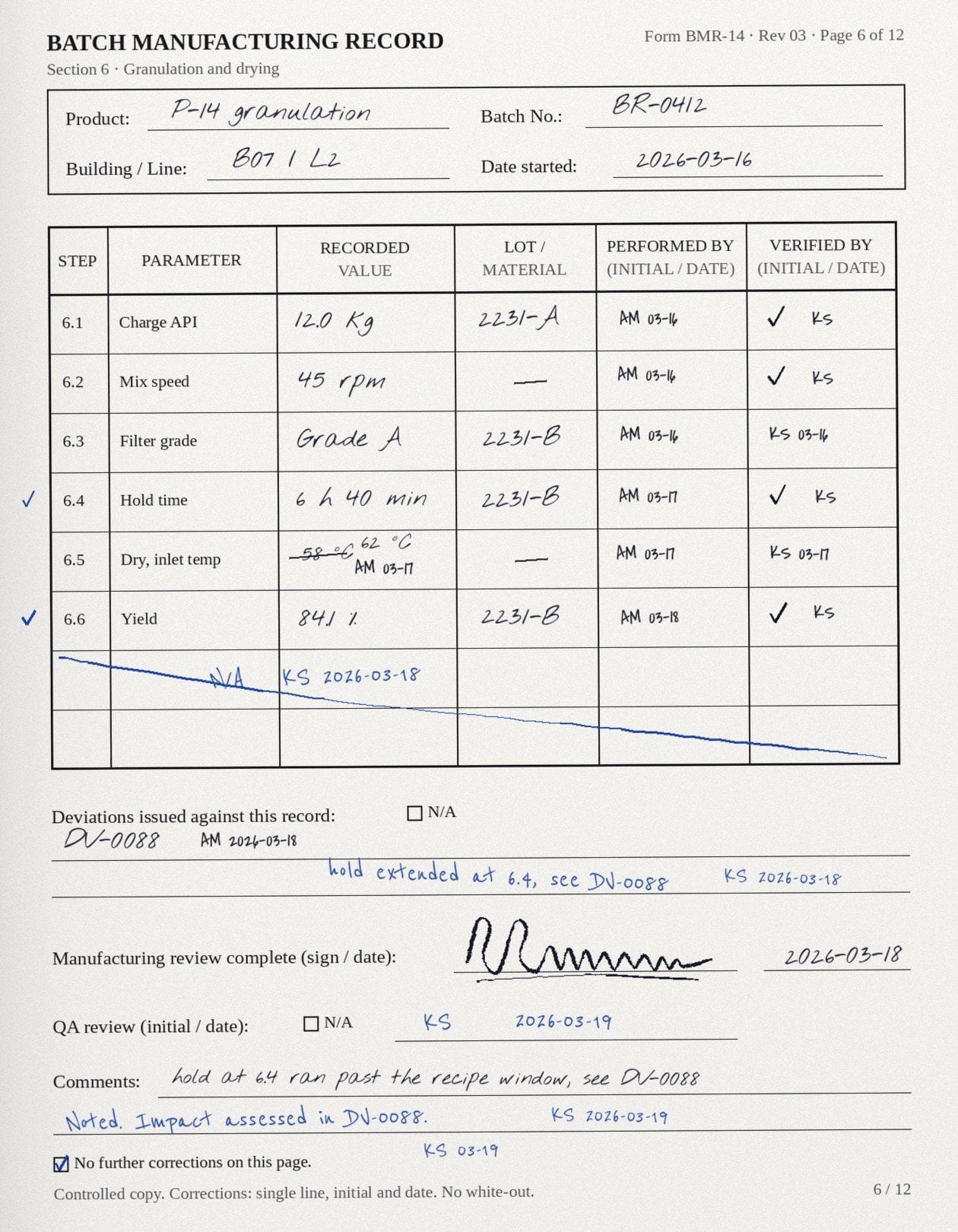
An executed paper batch record is a static record: its content is fixed on the page. A scan produced through a controlled process and verified against the original can be a true copy of it. 21 CFR 211.180(d) allows records to be retained "either as original records or as true copies such as photocopies, microfilm, microfiche, or other accurate reproductions."
What makes a scanning process defensible is usually the same set of controls:
- A written procedure for scanning, including resolution, color, and handling of double-sided pages.
- A check that every page was captured and is legible, including small handwriting, corrections, and margin notes.
- Verification, either by a person who signs and dates the check or by a scanning process that has been validated.
- Secure storage with access control and an audit trail, since the copy is now a GMP record.
Static and dynamic records
FDA's guidance draws a line that matters here. A static record, such as a paper form or a fixed image, can be preserved by a copy. A dynamic record, one the user can interact with, such as chromatography data that can be reprocessed, cannot be preserved by a printout or PDF, because the copy loses the ability to reconstruct the analysis. For those records the true copy has to keep the dynamic format and its metadata.
| Record | Static or dynamic | Can a scan or PDF be a true copy? |
|---|---|---|
| Executed paper batch record | Static | Yes, if verified |
| Signed paper certificate of analysis (CoA) | Static | Yes, if verified |
| Chromatography data system result | Dynamic | No; the copy must keep the data and metadata needed to reprocess it |
Can the paper originals be destroyed?
The guidance allows true copies to be retained in place of originals, but it does not make destroying originals automatic. MHRA's guidance says a true copy may be retained in place of the original if a documented system verifies the copy, and asks organizations to consider the risk of destroying originals. The decision belongs in the operation's quality system, supported by a documented risk assessment.
A true copy is not yet data
A verified scan preserves the record. It does not make the values inside it usable. Nobody can query a scanned yield or trend a scanned hold time. Digitizing the contents, extracting each value into a schema with a link back to the true copy or original, is a separate step, and the extracted data has its own integrity requirements: each value attributable to its source, accurate and available for the retention period. The guide “The complete guide to pharmaceutical document digitization” covers that step, and Document Intelligence keeps every extracted value linked to the page it was read from.
Questions
- Is a scanned batch record a true copy?
- It can be, if it preserves the full content and meaning of the original, including its metadata, and is verified by a dated signature or a validated process. An unverified scan is a convenience copy, not a true copy.
- Does FDA allow electronic true copies of paper records?
- Yes. In its 2018 data integrity guidance, FDA says electronic copies can be used as true copies of paper or electronic records provided they preserve the content and meaning of the original, including the metadata needed to reconstruct the activity.
- Is a PDF of chromatography results a true copy?
- No. FDA's guidance treats reprocessable chromatography data as a dynamic record, and a static printout or PDF cannot preserve the ability to reconstruct the analysis.
- Does 21 CFR Part 11 apply to scanned records?
- Where the electronic copy is the record relied on for a GMP purpose, Part 11's controls for electronic records apply, including audit trails and access control. FDA's 2003 Part 11 scope guidance interprets the rule narrowly and points firms to the predicate rules.
Sources
- Data Integrity and Compliance With Drug CGMP: Questions and Answers (Q1, Q9, Q10). , U.S. FDA, December 1, 2018
- 'GXP' Data Integrity Guidance and Definitions, Revision 1, MHRA, March 1, 2018
- TRS 1033, Annex 4: Guideline on data integrity., WHO, January 1, 2021
- 21 CFR 211.180, U.S. Code of Federal Regulations, October 6, 2026
- Part 11, Electronic Records; Electronic Signatures: Scope and Application, U.S. FDA, August 1, 2003
Read next
- September 23, 2026What FDA's draft AI guidance asks for, and what it leaves out

FDA's draft guidance Considerations for the Use of Artificial Intelligence To Support Regulatory Decision-Making for Drug and Biological Products, issued in January 2025 and still a draft as of September 2026, sets out a seven-step, risk-based framework for establishing that an AI model is credible for a defined context of use. It applies to AI that produces information supporting regulatory decisions about a drug's safety, effectiveness, or quality. It excludes AI used in drug discovery and AI used for operational efficiencies that do not affect patient safety.
- October 2, 2026How to digitize paper batch records without losing the source
Digitizing a paper batch record means reading every value on the executed record, including handwritten entries, corrections and signatures, and loading into a defined schema, with each value linked to the location it came from. The steps are to define the schema, capture a good image, extract, check against rules, have an expert review flags, and deliver the approved data. Keeping the link to the source at every step is what makes the result usable in regulated work.
Document Intelligence
Turns records from suppliers, CROs, CDMOs and your labs into contextualized, source-linked data.
See How It Works