OCR vs intelligent document processing for pharmaceutical records


In brief
Optical character recognition (OCR) makes scanned records searchable and their text easier to work with. The harder task is turning what appears on the page into data that retains its meaning: the right value, field, unit, process step, and correction history. In regulated contexts, that’s critical. Intelligent document processing adds classification and field extraction and can support the checks and review this requires. Its functional value in pharma depends on how well the configured workflow handles real records and keeps each result traceable to its source.
Key takeaways
- OCR turns text in scanned records into searchable, machine-readable content. In pharmaceutical workflows, readable text alone is only part of what's needed.
- A correctly recognized number can still be unusable if it loses its unit, process step, or relationship to a corrected entry.
- Strikethroughs, corrected values, and margin notes carry meaning. Pharmaceutical document processing needs to preserve how those entries relate to the original record, beyond recognizing the individual characters.
- Intelligent document processing can add the structure pharma needs through classification, field mapping, rules, and review. Those capabilities need to be demonstrated on the intended records.
- General document benchmarks are a starting point for evaluation. Test representative pharmaceutical records to establish field accuracy, source traceability, and whether important errors reach review.
What is optical character recognition (OCR)?
Optical character recognition (OCR) is technology that converts printed or handwritten text in scanned documents and other images into machine-readable text. It makes scanned records searchable and reduces the need to retype their contents. Recognizing that text does not, on its own, establish what an extracted value means.
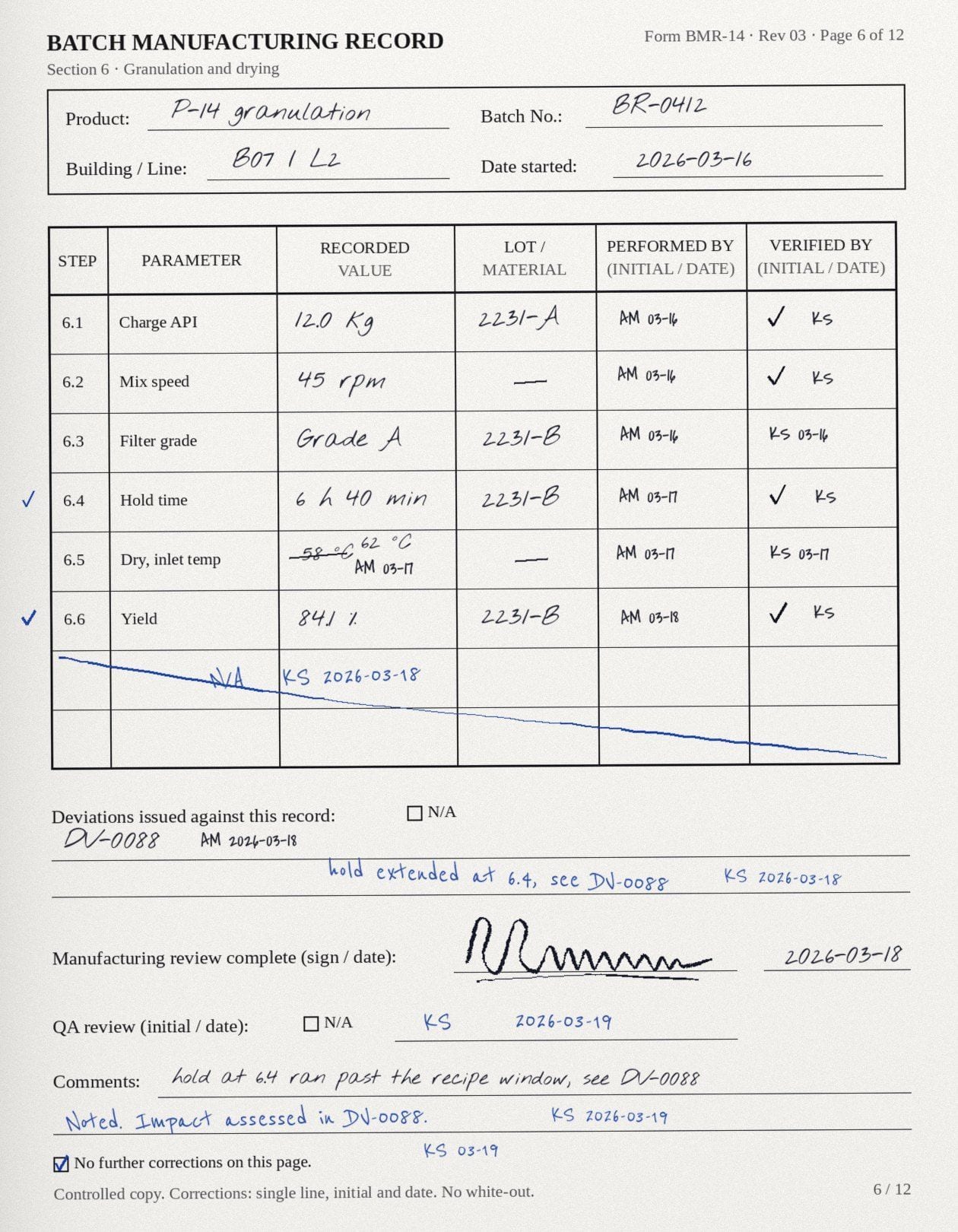
On an executed batch record, the letters and numbers of BR-0412 might be read correctly without being assigned to the right field or correctly associated. A number below it needs to be connected with the right process step, parameter, and unit. That mapping is a separate task from recognizing the characters.
A searchable scan makes a record easier to find and read. Using its contents in a pharmaceutical workflow takes more work: mapping values to defined fields while preserving the context needed to check and use them.
What is intelligent document processing (IDP)?
Intelligent document processing (IDP) builds on text recognition to identify document types and organize their contents into defined fields. Depending on the implementation, it can also include validation rules, exception handling, and human review. For a pharmaceutical batch record, that means going from reading a number to associating it with the right parameter, unit, and process step, then checking it and routing uncertain results for review.
Custom classification and extraction models can extend these systems to an organization’s own documents. For pharmaceutical records, that flexibility is a starting point. The configured system still needs to handle the relationships, corrections, and review requirements found in executed records.
For a pharmaceutical buyer, the useful question is how the system moves beyond recognizing text: which record types and field relationships it handles, how it preserves context, and what evidence demonstrates that support.
Why pharmaceutical records need more than text recognition
An executed record can mix printed instructions with handwriting, corrections, and notes added over several shifts. A system may recognize the individual characters yet assign a value to the wrong field or miss the relationship between a note and a process step. Tests should examine those relationships as well as transcription.
Consider a corrected entry: the original value, replacement, initials, and date together explain the change. Returning only one number can lose that history. The same test set should cover margin notes and tables that continue across pages, checking that each value remains associated with the right parameter.
| On the page | Possible extraction failure | What the record needs |
|---|---|---|
| Printed batch identifier BR-0412 | Correct text without a field assignment | A batch identifier field, checked against the record it belongs to |
| A handwritten yield | An incorrect reading that isn't flagged | A value, its unit, and a flag where the reading is uncertain |
| A struck entry with initials and a date | Both values without their correction relationship | The amended value, with the superseded entry, the initials, and the date kept beside it |
| A process table continuing on the next page | Rows separated from their column headings | One table, with every row still attached to its parameter |
A configured system may handle them correctly; a specific evaluation needs to prove it.
GMP rules applicable to OCR and IDP
When OCR or IDP is used to extract data from GMP records for quality review or transfer into another system, text recognition and field extraction sit within a broader set of controls. In the U.S., 21 CFR 211.68(b) requires computer input and output to be checked for accuracy, with the degree and frequency based on the system’s complexity and reliability. The provision does not set a universal extraction-accuracy percentage.
The need to check computerized results predates modern OCR and IDP. FDA’s 1987 CPG Sec. 425.400 explains that even validated systems can produce input and output errors. It also clarifies that not every input and output must be checked; the extent and frequency depend on the system’s complexity and built-in controls.
FDA’s 2018 guidance, Data Integrity and Compliance With Drug CGMP: Questions and Answers, addresses a broader data-integrity picture: completeness, consistency, accuracy, and the metadata that gives data its context. It recommends preserving the relationships between data and metadata and making errors and omissions detectable. Read together, the two documents connect a longstanding need to check results with more detailed guidance on preserving their meaning. For OCR and IDP, that means checking both the extracted values and the context needed to interpret them.
For an extraction system, this means planning how its results will be checked before they are used. A practical starting point is to define what those results must contain so a reviewer can assess them against the source record.
Defined schemas enable reviewable results
A schema defines the fields and relationships that extracted data must fit. For an executed batch record, it might specify the batch identifier, process step, parameter, recorded value, and unit. It should also describe how corrections and annotations are represented, so their meaning survives extraction.
For example, a corrected yield entry needs more than a field containing a number. The data should distinguish the replacement value from the superseded entry, retain any associated initials and date, and connect the correction to the relevant process step. A margin note should remain associated with the entry it explains.
The schema defines how that information is organized; source links and review controls make it possible to check. Each extracted value should be traceable to its location in the record, and missing or uncertain information should be visible to the reviewer. These capabilities need to be demonstrated in the configured system.
Applying intelligent document processing to pharmaceutical records
Consider an executed batch record being prepared for quality review. OCR recognizes the text on each page. IDP then maps the relevant content into the defined fields, associates values with their units and process steps, and preserves correction history and annotations. Source links let the reviewer compare the extracted data with the original entries. Document Intelligence applies this approach to pharmaceutical records.
Checks can then flag missing fields, unexpected units, or values outside defined limits. Uncertain handwriting and ambiguous corrections should be routed to a reviewer for resolution. Once the relevant checks and approvals are complete, the structured data can support quality review or be transferred into the corresponding fields in another system.
Before using the extracted data for either purpose, test the configured system on representative executed batch records, including strikethroughs, margin notes, and tables that span pages. Compare both the values and their relationships with verified reference data, and confirm that important errors reach review. This shows whether the system can produce usable batch-record data, beyond recognizing the text.
Questions
- Is OCR enough to digitize a batch record?
- OCR is useful for making a scanned batch record searchable and providing text for extraction. Using that content as structured pharmaceutical data requires more: field mapping, source links, checks, and appropriate review. OCR supplies the text; the wider workflow needs to preserve what that text means.
- Is intelligent document processing the same as OCR?
- No. OCR recognizes text, while intelligent document processing typically adds classification and field extraction and may include rules and review. Custom models can address an organization’s own records; the label alone does not establish suitability for GMP use.
- What extraction accuracy should we expect on handwritten entries?
- It depends. First, define whether the metric measures characters, fields, or complete records, then test representative handwritten entries against verified reference values. Include corrections, units, and errors that the review process could miss.
- Can a vendor's benchmark score serve as validation evidence?
- Not alone. It can contribute supporting evidence, but it cannot establish suitability by itself. Assess what was tested, which metrics were used, and whether the results apply to the intended records and use. Test the configured extraction system on representative batch records before relying on its results.
Sources
- 21 CFR Part 211.68. Automatic, mechanical, and electronic equipment, U.S. Code of Federal Regulations, November 12, 2026
- Data Integrity and Compliance With Drug CGMP: Questions and Answers, U.S. FDA, December 2018
- CPG Sec. 425.400, Computerized Drug Processing; Input/Output Checking, U.S. FDA, September 4, 1987
Read next
- September 15, 2026The complete guide to pharmaceutical document digitization

Pharmaceutical document digitization is the process of reading GxP records such as executed batch records and certificates of analysis into a defined schema, with every value linked back to the page it came from. A scan by itself is a picture, not data. Done well, digitization produces structured data that reviewers can check against the source, that meets the regulatory expectation for accurate and complete records, and that other work can build on. This guide covers how digitization works, what OCR is and how to evaluate its accuracy, and how to build trust with digitization technology.
- October 2, 2026How to digitize paper batch records without losing the source
Digitizing a paper batch record means reading every value on the executed record, including handwritten entries, corrections and signatures, and loading into a defined schema, with each value linked to the location it came from. The steps are to define the schema, capture a good image, extract, check against rules, have an expert review flags, and deliver the approved data. Keeping the link to the source at every step is what makes the result usable in regulated work.
- October 5, 2026How to digitize certificates of analysis from suppliers

Digitizing a supplier certificate of analysis (CoA) means extracting the material, lot, tests, specifications, results, and methods into one schema, with each value linked to the certificate it came from, whatever layout the supplier used. The steps are to define one schema for every supplier, map each supplier's terms to it, extract, check the results against the specification, and review anything flagged. Structured certificate data makes it practical to trend a supplier's results across lots and to support the verification of supplier data that 21 CFR 211.84 requires.
Document Intelligence
Turns records from suppliers, CROs, CDMOs and your labs into contextualized, source-linked data.
See How It Works